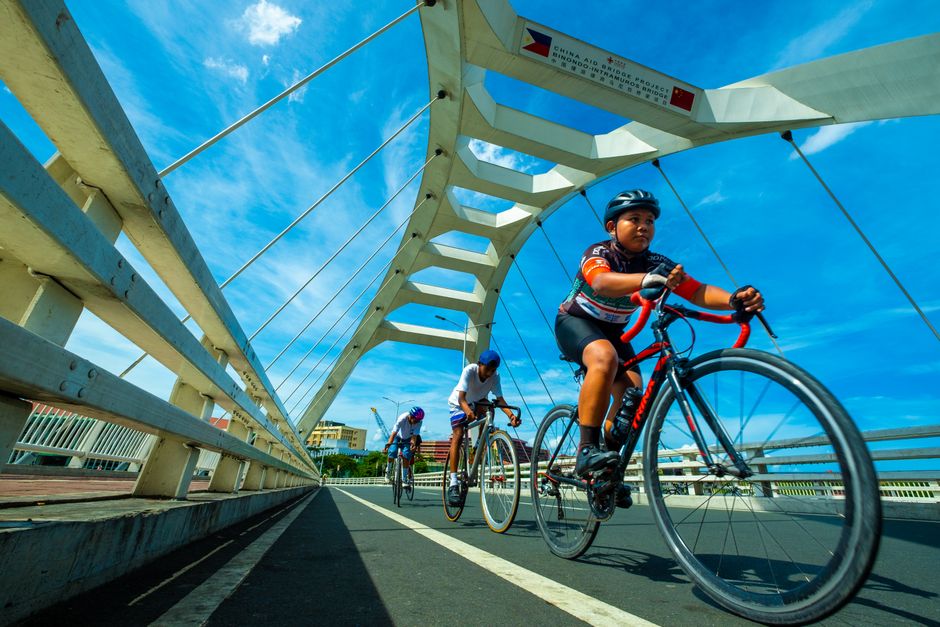
Every Sunday morning, roughly 3,000 cyclists roll onto Roxas Boulevard before 8 a.m. That number, tracked by the Metropolitan Manila Development Authority during its 2025 open-street counts, has held steady since the agency permanently extended its car-free lane policy along the 7.6-kilometre coastal stretch in March of that year. Families with children on balance bikes, retired couples on e-bikes, and office workers on foldable Trinx commuters all share the same flat, shaded corridor — and that mix is the point.
The city's relationship with recreational cycling has been building for years, but the past eighteen months mark a meaningful shift. The Department of Transportation's Safe Pathways for Active Mobility program, allocated ₱480 million in the 2026 national budget, is funding protected lane demarcation, rest stops, and bike-parking infrastructure at six priority corridors across Metro Manila. For beginners especially — anyone who hasn't been on a bicycle since childhood or is nervous about traffic — the timing is unusually good.
Where to Start: Manila's Most Beginner-Friendly Corridors
Roxas Boulevard remains the gold standard. The dedicated bike lane runs from the Cultural Center of the Philippines complex in Pasay north toward Ermita, with virtually no elevation change. Rental bikes are available from Bayshore Bike Hub, a kiosk operating near the CCP Main Theater entrance, for ₱60 per hour on weekdays and ₱80 on weekends. The surface is well-maintained asphalt, lane markings were repainted in January 2026, and the sea breeze off Manila Bay keeps temperatures tolerable even in July.
Intramuros offers something different — a slower, more scenic loop inside the walled city. The circumference road around the walls is approximately 4.4 kilometres, mostly flat, and largely free of through-traffic on Sundays when private vehicles are restricted from the core heritage zone under a City of Manila ordinance active since 2023. Children do well here because speeds stay low and the forgiving pace encourages stops at Fort Santiago or the Baluarte de San Diego garden. Intramuros Administration staff stationed near the Muralla Street entrance can point cyclists toward the safest starting point inside the walls.
BGC — Bonifacio Global City in Taguig — functions as Metro Manila's most complete cycling ecosystem for families. The 10-kilometre inner ring of dedicated lanes connecting Burgos Circle to the Mind Museum and back is lit, monitored by CCTV, and patrolled by BGC's private security force. Bikers' Lane PH, a local advocacy group with over 42,000 Facebook followers, runs free group rides for beginners here every first Saturday of the month, departing from Mckinley Parkway at 6:30 a.m. Participation is free; riders are asked only to wear a helmet and bring water.
Gear, Safety, and Getting the Most Out of Your Ride
Helmets are non-negotiable and, since April 2026, legally required for cyclists under 18 anywhere in Metro Manila following an amendment to the city's Road Safety Ordinance. Decent entry-level helmets sell for ₱350 to ₱600 at Toby's Sports branches in SM Mall of Asia and Glorietta. For those who don't own a bike, the Pasig City government's Biyahe ng Buhay program operates a fleet of 200 share-bikes across 15 docking stations; access costs ₱25 for the first 30 minutes via the city's GovPH partner app.
Timing matters. July heat peaks between 10 a.m. and 3 p.m., so rides before 8:30 a.m. or after 5 p.m. are strongly advisable. Hydration stops along Roxas Boulevard are spaced roughly every 1.5 kilometres. Families with very young children should consider starting on a 2- to 3-kilometre loop rather than the full Roxas stretch — the Luneta Park perimeter road inside Rizal Park is ideal for that, with wide lanes, shade trees, and easy bail-out points near the National Museum cluster.
Anyone with specific health conditions — joint issues, cardiovascular concerns, or post-injury rehabilitation — should consult a local sports medicine physician before starting a regular cycling program. St. Luke's Medical Center in BGC and The Medical City in Ortigas both operate sports medicine outpatient clinics that handle cycling-related fitness assessments. The city's infrastructure is finally ready for newcomers; the question now is simply whether residents are ready to use it.